

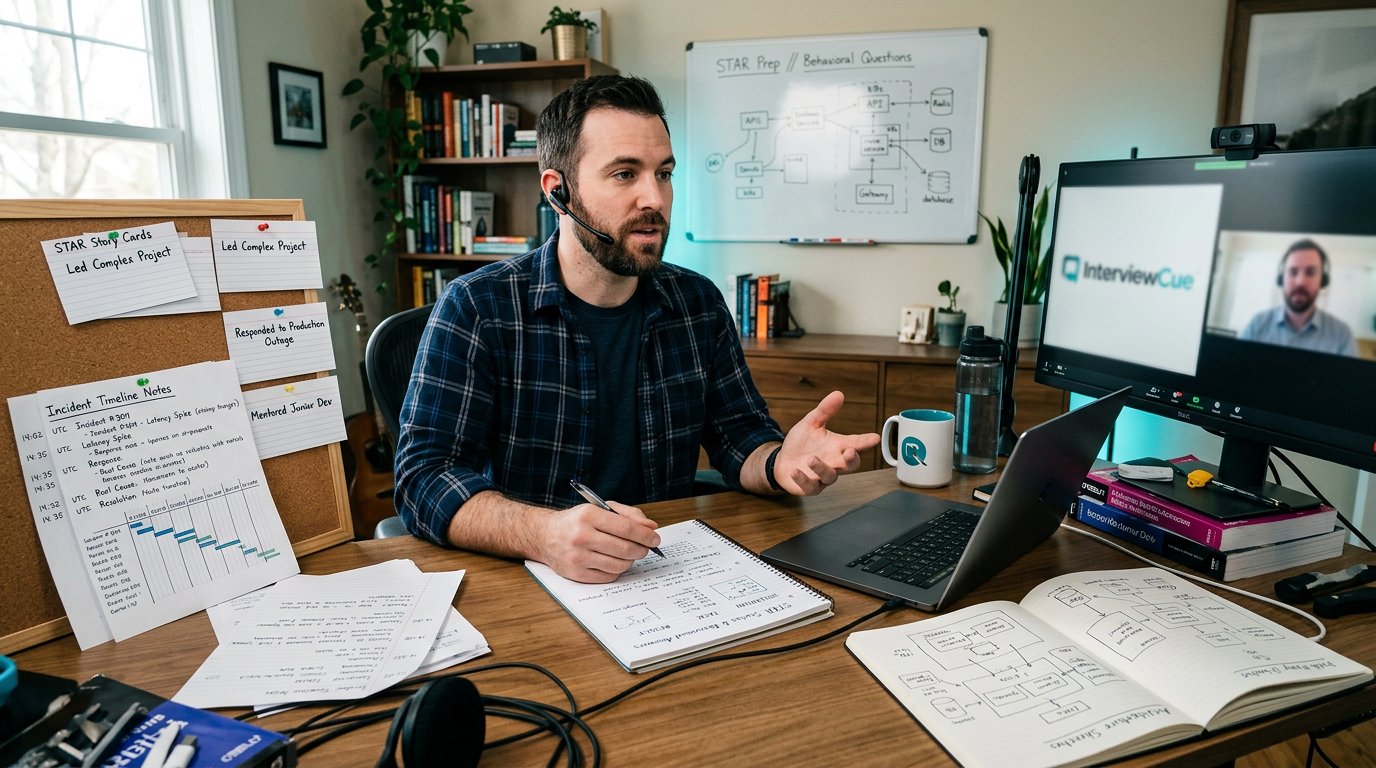
Useful greatest weakness examples describe a real limitation, its work impact, actions already taken, and current progress. Choose something relevant to the role, then check whether it exposes a gap in a core requirement. A credible answer shows how you manage the weakness today, without pretending it has disappeared.
These options are not a statistical ranking. No answer guarantees an offer.
Choose a Weakness
Read the job description before choosing. Robert Half’s interview guidance recommends reviewing role requirements and drawing on actual feedback. A manageable development area in one job can be a serious mismatch in another.
| Weakness direction | Consider when | Avoid when |
|---|---|---|
| Large-audience speaking | Mostly small-team work | Frequent keynote or client presentations |
| Overly detailed explanations | You can show clearer recent updates | Executive communication is central |
| Asking for help late | Routine development work | Urgent incident escalation is essential |
| Minor-detail overinvestment | You now prioritize by impact | You still miss critical deadlines |
| Uncertain-task estimates | Exploratory project work | Independent delivery forecasting is core |
| Frequent task switching | Work permits focus blocks | Constant real-time triage |
| Limited delegation | You have led or allocated work | You have no delegation experience |
| Late scope pushback | You can show earlier tradeoff discussions | Scope negotiation is a core gap |
| Non-core domain knowledge | The domain is learnable on the job | Domain expertise is required immediately |
| Slow cross-team networking | A bounded individual contributor role | Partnership building defines the job |
Weakness Answer Examples
These are fictional teaching examples; every situation and outcome is invented. Choose a direction matching your experience and replace the details with facts you can explain.
Speaking to large audiences
In practice / when to use: You rush larger presentations despite being comfortable with teammates. Consider this when large-group speaking is occasional.
“I’m less confident presenting to large audiences. During a project demo, I rushed the explanation and left people unclear about the rollout. I now rehearse with a teammate and use a three-point outline. In my latest update, I paused to check understanding and left time for questions. I still get nervous, but my delivery is more organized.”
- Why it works: Names a specific communication cost and shows a changed presentation habit.
- Improve: Record a short demo weekly; ask a listener to summarize its message.
- Avoid: Developer advocacy, training, or sales roles requiring frequent large-audience presentations.
- Likely follow-up: “How would you prepare for a customer presentation?”
Overexplaining technical details
In practice / when to use: Details bury your recommendation. Use with evidence of clearer communication across technical and business audiences.
“I sometimes give too much technical detail before explaining why it matters. In one planning meeting, I described caching options before the customer problem, slowing the discussion. I now lead with the impact, recommendation, and decision needed. Recent reviews have reached decisions without retracing my explanation. I still prepare detailed notes, but save them for questions.”
- Why it works: Shows audience awareness through a concrete change in information order.
- Improve: Rehearse a 30-second recommendation; move technical depth into an optional appendix.
- Avoid: Roles where concise executive communication remains a major unmet requirement.
- Likely follow-up: “Explain your latest project to a nontechnical stakeholder.”
Debugging alone for too long
In practice / when to use: You repeat investigations before asking for help. Use for ordinary project work where you’ve improved escalation judgment.
“I used to debug alone too long. On one integration issue, repeated checks delayed a teammate’s testing. I now set an investigation checkpoint, summarize what I’ve ruled out, and ask for help when progress stalls. Recently, that summary helped us find a missing configuration together. I still investigate independently, but escalate sooner when others are blocked.”
- Why it works: Connects the delay to someone else’s work and defines an escalation trigger.
- Improve: Set a blocker checkpoint; share symptoms, attempted fixes, and a focused question.
- Avoid: Incident-response roles if you still hesitate to follow urgent escalation procedures.
- Likely follow-up: “What makes you escalate before the time limit?”
Spending too long on minor details
In practice / when to use: Polishing crowds out higher-value work. Name the cost and changed priorities.
“I’ve spent too long polishing minor details. On an internal dashboard, I adjusted spacing before finishing handoff notes, leaving the reviewer waiting for context. I now agree on acceptance criteria and separate necessary fixes from optional polish. My latest handoff included notes with the first review. I still notice inconsistencies, but prioritize them by usability and impact.”
- Why it works: Admits a real tradeoff rather than presenting perfectionism as a hidden strength.
- Improve: Timebox optional polish; review the highest-impact unfinished requirement first.
- Avoid: Any situation where missed critical work remains unresolved; don’t minimize it as polishing.
- Likely follow-up: “How do you distinguish a minor detail from a quality issue?”
Underestimating uncertain tasks
In practice / when to use: You overlook unknown dependencies. Consider this for exploratory work, with evidence of earlier risk communication.
“I can underestimate tasks with unfamiliar dependencies. On one integration, I overlooked external-service validation, compressing our review window. I now list assumptions, investigate the riskiest unknown first, and give an estimate range. For my latest integration, I revised the estimate after discovery and informed the team immediately. I’m getting better at separating implementation work from unknowns.”
- Why it works: Explains the forecasting error and how uncertainty becomes visible sooner.
- Improve: Compare estimates with actuals; record overlooked dependencies and update stakeholders at checkpoints.
- Avoid: Delivery leadership roles requiring forecasting expertise you cannot yet demonstrate.
- Likely follow-up: “What do you do when the deadline cannot move?”
Losing momentum when switching tasks
In practice / when to use: Frequent interruptions cause repeated setup work. Consider this when the role allows planned focus periods.
“Frequent task switching slows me down. Alternating between a feature and small requests once delayed my review. I now clarify urgency, group routine requests into agreed windows, and leave restart notes before switching. Last sprint, that kept the review moving while I handled important requests. I still need structure when interruptions increase, and reprioritize urgent work with the team.”
- Why it works: Shows prioritization while acknowledging that urgent requests still need attention.
- Improve: Write the next action before switching; agree response expectations with teammates.
- Avoid: Live support, incident command, or other jobs built around continuous triage.
- Likely follow-up: “How would you handle two urgent requests at once?”
Delegating too little
In practice / when to use: You retain work others could own. Choose this only with genuine team leadership or task-allocation experience.
“When I first coordinated a project, I kept too many tasks myself, becoming a bottleneck and limiting teammates’ ownership. I now agree on outcomes, boundaries, and review points, then let the owner choose the approach. On a recent release, a teammate owned validation while I handled dependencies. I’m still learning when to step back, but delegate more deliberately.”
- Why it works: Recognizes both delivery cost and the effect on teammates’ ownership.
- Improve: Delegate a bounded outcome with decision rights and checkpoints, not constant approvals.
- Avoid: Candidates without allocation experience; managers whose unresolved delegation gap prevents team delivery.
- Likely follow-up: “What do you do when someone chooses a different approach?”
Raising scope concerns too late
In practice / when to use: You accept additions before discussing tradeoffs. Use when recent examples show earlier, constructive pushback.
“I’ve raised scope concerns too late. On one feature, accepting several additions without discussing their combined impact squeezed testing time. I now record requests, estimate their impact, and ask which commitment should move. Recently, we deferred an optional addition and protected release checks. I still want to help, but make tradeoffs visible rather than silently absorbing extra work.”
- Why it works: Takes responsibility and replaces silent acceptance with an explicit decision.
- Improve: Use a change log; propose a scope, date, or resource tradeoff promptly.
- Avoid: Product or program leadership roles if negotiating scope is still a fundamental gap.
- Likely follow-up: “How would you push back on a senior stakeholder?”
Limited experience in a non-core domain
In practice / when to use: A specific adjacent business area is unfamiliar. Use only when immediate expertise in that area is optional.
“My subscription-billing experience is limited. On one task, uncertainty about refund behavior added review cycles. I started mapping business terms, checking examples with a domain specialist, and documenting assumptions before implementation. Recently, I could explain the main lifecycle and flag areas needing review. I don’t claim deep expertise yet, but now have a clearer process for validating my understanding.”
- Why it works: Defines a narrow knowledge boundary and avoids claiming expertise after brief exposure.
- Improve: Map key workflows; validate edge cases with an experienced domain owner.
- Avoid: Billing-specialist roles or other jobs requiring that exact domain from day one.
- Likely follow-up: “Which domain assumptions would you validate first?”
Building cross-team connections slowly
In practice / when to use: You contact partner teams late. Consider this for bounded roles with an improved outreach habit.
“I can be slow to build cross-team connections. On one project, late outreach meant discovering a partner’s review process too late. I now identify partner teams at kickoff and ask about ownership and lead times. Recently, that helped us schedule a review earlier. Outreach still feels easier with a purpose, so I include introductions in my project checklist.”
- Why it works: Describes a collaboration behavior and its consequence without labeling personality as a defect.
- Improve: Map dependencies at kickoff; introduce yourself to owners before requesting delivery commitments.
- Avoid: Partnership, staff leadership, or management roles centered on proactive cross-team influence.
- Likely follow-up: “How do you maintain those relationships after kickoff?”
Choose Your Real Example
Use these filters before rehearsing:
- Start with evidence
Review feedback, retrospectives, or a task that took longer than expected. Choose a recurring behavior you can describe fairly.
- Check role fit
Compare it with the job’s essential responsibilities. If you have a core skill gap, assess your readiness honestly; changing the story won’t close it.
- Show action taken
A course enrollment is a start; explain the habit or practice you’ve actually applied.
- Name observable progress
A clearer handoff, earlier escalation, or changed review process counts. Use numbers only when you have them.
The behavioral interview guide explains how evidence supports answers about judgment and learning. The weakness question need not become a full STAR story; a short example can make the improvement credible.
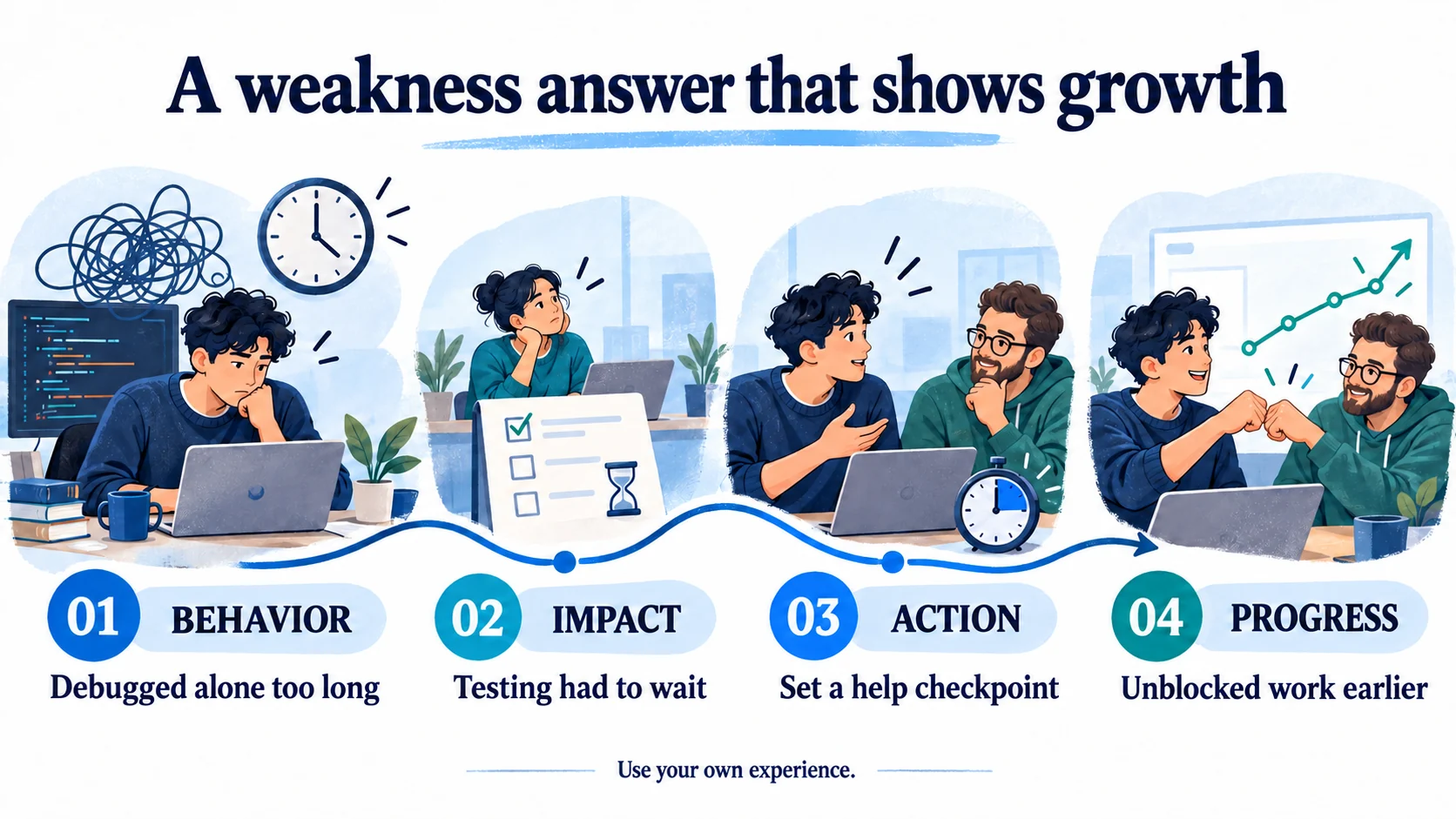
Build Your Answer
Organize your facts, then rewrite in your speaking voice:
Behavior → Impact → Action → Progress
- 01 Weakness
- “One area I’m improving is [specific behavior and situation].”
- 02 Impact
- “In [real example], I [what happened], which [work impact].”
- 03 Action
- “I’ve since [action already taken] and [repeatable habit].”
- 04 Progress
- “In [recent situation], [observable progress]. I still [remaining limitation], so I now [how I manage it].”
Replace each bracket with your own facts, then connect the lines in your speaking voice.
The STAR answer generator can help organize the situation, action, and result. Supply your own facts and remove unsupported details. Explain the cost without reciting the project’s history.
Weakness answers to avoid
- “I have no weaknesses.” Identify a genuine development area rather than denying limitations.
- “I work too hard” or “I’m a perfectionist.” A flattering label doesn’t explain a cost. Describe the behavior and what changed, as in the minor-details example.
- “I’m bad at communication.” Narrow the issue to a situation you can explain and manage.
- “I’ll improve once I’m hired.” Discuss action already underway, even if progress is modest.
- “My team caused the problem.” Explain your contribution and response without shifting responsibility.
The National Careers Service similarly advises honest weakness answers that explain improvement. You don’t need to present the issue as completely solved.
Weakness Answer FAQ
How long should a weakness answer be?
Aim for roughly 45–90 seconds as a practice target, not a hiring rule. Cover one weakness, an example, actions, and progress, then allow follow-ups.
Do I need a specific example?
Usually, a brief example makes the impact clearer. Choose details you remember and can explain under follow-up questioning; a dramatic failure isn’t necessary.
What if I have no work experience?
Use a real class project, volunteer role, club activity, or personal project. Identify it accurately. The National Careers Service also accepts examples outside employment. Don’t turn a classroom collaboration into a fictional job or claim delegation you never performed.
What if the interviewer asks for several weaknesses?
Prepare two or three genuine options, then answer the number requested. Give each a distinct behavior and improvement. Don’t stretch one issue into several labels or recite all ten examples from this guide.
Conclusion
Choose one of these greatest weakness examples only if it reflects your experience. Draft four factual bullets, say the answer aloud, and rehearse its follow-up. Use these behavioral questions for software engineers to practice related evidence about teamwork and judgment.
For spoken rehearsal, explore InterviewCue AI and its AI mock interview workflow. Check whether your answer makes the impact, action, and progress clear. Revise for accuracy before polishing delivery.