


Choosing good questions to ask at the end of an interview helps you understand the work and decide whether the role fits you. Pick a few relevant questions based on who is interviewing you, what you have already discussed, and the time remaining. You do not need to work through all 20.
Choose Your Questions
These are conversation options, not a ranking or a formula for getting hired. CareerOneStop’s interview preparation guidance encourages candidates to assess the opportunity and prepare questions informed by employer research.
| What you want to learn | Best person to ask | Question numbers |
|---|---|---|
| Hiring steps and preparation | Recruiter | 1, 2, 4 |
| Role level and hiring background | Recruiter; manager for detail | 3, 5 |
| Expectations and ownership | Hiring manager | 6–9 |
| Growth in practice | Hiring manager | 10 |
| Engineering quality and operations | Technical interviewer on the team | 11–15 |
| Collaboration and everyday work | Future coworker | 16–20 |
In small companies, one person may cover several roles. Interviewers from other departments may know little about your future team.
Recruiter: Process and Scope
1. What are the next steps?
Ask at the end of a screening call or whenever the process is unclear. This establishes the sequence ahead and who coordinates it. Listen for remaining conversations, scheduling dependencies, and whether an assessment comes next; an estimated schedule is not a commitment.
Follow-up: “Who should I contact if I have a scheduling question?”
2. What will later stages assess?
Use this before a multi-stage interview loop to understand what each conversation evaluates. Listen for coding, design, project discussion, or collaboration topics, rather than assuming every round repeats the same assessment. Amazon’s software interview guide specifically recommends asking your recruiting contact which subjects and skills to prepare for.
Follow-up: “Will any stage involve a presentation or practical exercise?”
3. How are this role’s level and scope defined?
Ask when the title seems broad or the posting covers several experience levels. You are clarifying expected responsibility, not negotiating a title in isolation. Listen for project size, independence, mentoring expectations, and whether the level is fixed or determined through interviews. Recruiters may need the manager to explain team-specific examples.
Follow-up: “What distinguishes this level from the one above it?”
4. What should I prepare for the next stage?
Ask once you know the next round’s focus. This concerns logistics and permitted preparation, while question 2 concerns assessment content. Listen for tools, exercise duration, materials to bring, accessibility arrangements, and any preparation instructions. Request public resources or format details rather than confidential interview questions.
Follow-up: “Are there written instructions or platform requirements I should review?”
5. Is this a new role or a replacement?
Ask during an initial conversation when the hiring background has not been explained. The answer can reveal expansion, a reorganization, or continuity needs. Listen for whether the responsibilities are established or still developing. A replacement does not by itself imply a problem, and the recruiter may appropriately withhold personal details.
Follow-up: “Has the scope changed since the role was first planned?”
Hiring Manager: Goals and Growth
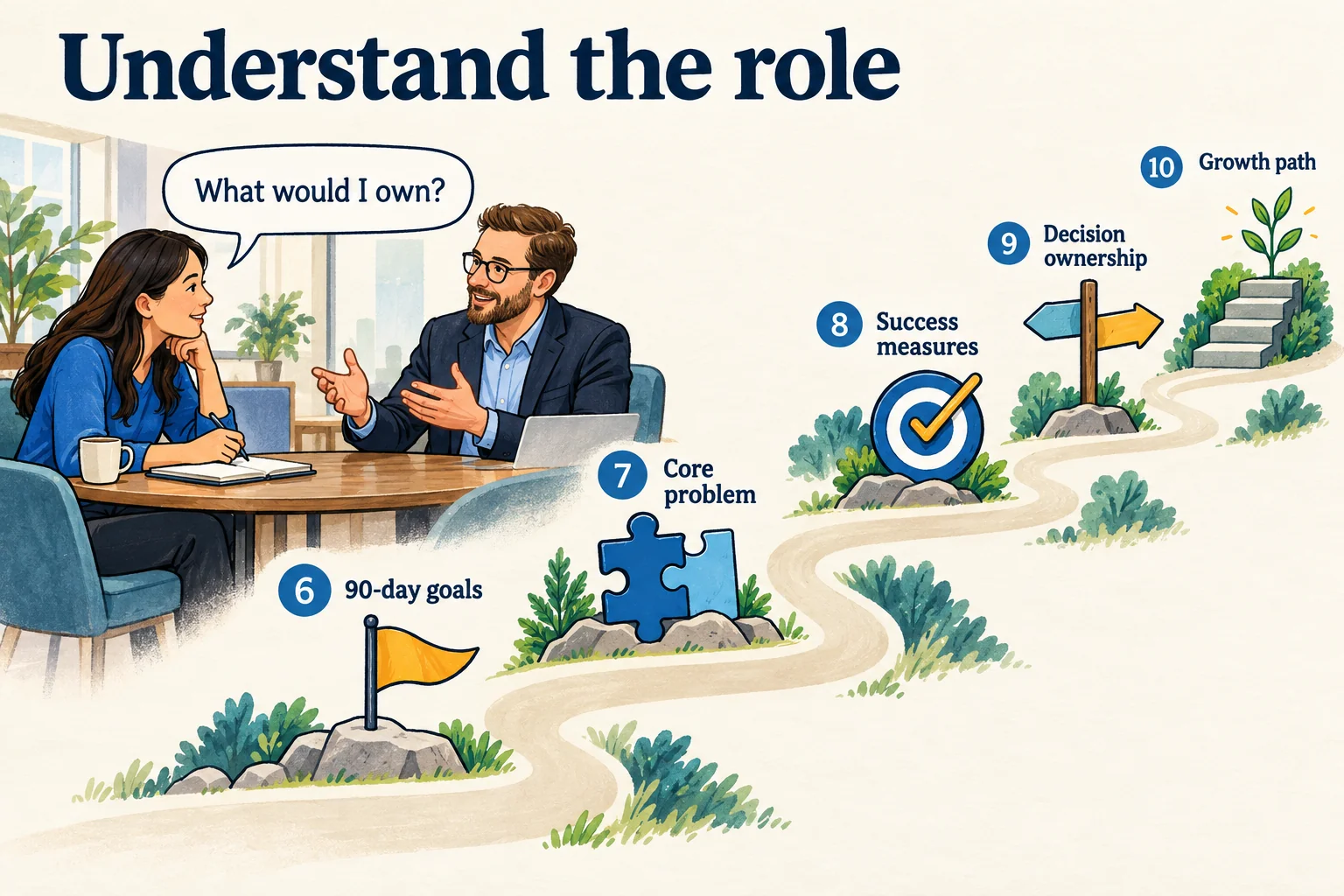
6. What should I accomplish in the first 90 days?
Use this after discussing the responsibilities, especially in a later round. It turns a job description into near-term expectations. Listen for learning time, achievable outcomes, support, and dependencies. A substantial early deliverable can make sense for an experienced hire; ask how onboarding and unfamiliar systems fit the timeline.
Follow-up: “Which of those outcomes would be the first priority?”
7. What is the biggest problem this hire should solve?
Ask when the posting lists many responsibilities but their priority remains unclear. This identifies the underlying hiring need: delivery capacity, reliability, customer understanding, or coordination, for example. Listen for the business impact and why the current team needs help. Compare the problem with the work you actually want to do.
Follow-up: “What has made that problem difficult to solve so far?”
8. How will success in this role be evaluated?
Ask after discussing goals to understand ongoing evaluation beyond the first project. Listen for review cadence, feedback sources, quality expectations, and how individual work connects to team outcomes. A metric is more useful when the manager explains its limitations and how changing priorities affect evaluation.
Follow-up: “How do you give feedback between formal reviews?”
9. Which decisions would I own or share?
Use this when the role emphasizes ownership, autonomy, or leadership. It clarifies decision authority and collaboration boundaries. Listen for examples involving implementation, architecture, roadmap scope, and escalation. Shared decisions are normal; the useful detail is how disagreements are resolved and who makes the final call.
Follow-up: “Could you walk me through a recent decision someone in this role made?”
10. How have teammates grown their responsibilities recently?
Ask when assessing development opportunities, particularly after learning the immediate expectations. A concrete example shows how growth happens beyond a general promise. Listen for coaching, stretch assignments, access to opportunities, and whether increased responsibility involved recognition. One person’s experience illustrates a path without guaranteeing yours will match it.
Follow-up: “What support helped them take on that additional responsibility?”
Technical Interviewer: Engineering Practices
Choose someone who works with the relevant systems. For broader preparation across coding and design rounds, use the software engineer interview prep framework before tailoring these questions to the team’s projects.
11. How does code review work here?
Ask after a coding or project discussion to understand everyday feedback and quality control. Listen for reviewer selection, turnaround time, review scope, and how unfamiliar contributors get context. A small team may use lightweight reviews; what matters is how it maintains quality and keeps work moving.
Follow-up: “What happens when a change is blocked waiting for review?”
12. How are changes tested and released?
Use this after discussing a service or feature you might work on. It reveals the path from a completed change to users. Listen for automated checks, manual testing, release ownership, rollout monitoring, and recovery options. Release frequency alone tells you little without the product’s risk and operating constraints.
Follow-up: “Who decides whether a change is ready to release?”
13. How do production incidents and on-call work?
Ask a team engineer when operational support may be part of the job. Listen for rotation size, actual alert frequency, escalation support, and training before independent coverage. Being on call means different things across teams; distinguish scheduled availability from typical interruptions, including nights and weekends.
Follow-up: “What did the last rotation look like for someone in this role?”
14. How do you prioritize technical debt?
Use this after hearing about older systems, migrations, or delivery pressure. The answer reveals how engineering risks compete with feature work. Listen for prioritization criteria, who advocates for maintenance, and a recent funded example. A deliberate short-term compromise can be reasonable if its costs and revisit conditions are understood.
Follow-up: “What is an example of maintenance work the team prioritized recently?”
15. What changed after your last incident or retrospective?
Ask once the conversation has covered delivery or reliability. Unlike question 13’s operating arrangements, this explores learning and follow-through. Listen for a specific change, an owner, and whether anyone checked its effect. Accept an anonymized example; the interviewer should not need to disclose confidential customer or incident details.
Follow-up: “How did the team check whether that change helped?”
Future Coworkers: Daily Work
16. How do product and engineering resolve priority conflicts?
Ask a prospective teammate after discussing planning or competing requests. This reveals how tradeoffs become decisions. Listen for shared evidence, decision owners, and how revised priorities reach the people doing the work. Disagreement is expected; a concrete example is more informative than a claim that everyone always agrees.
Follow-up: “Can you describe a recent tradeoff and how the decision was communicated?”
17. How do you balance meetings, collaboration, and focus time?
Use this when exploring a typical week, especially on a distributed team. Listen for recurring meetings, time-zone overlap, written communication, and how people protect concentration while remaining available. Match the pattern to the role: customer-facing engineers and individual contributors may have different collaboration needs.
Follow-up: “What does a fairly typical week look like for you?”
18. How are new teammates onboarded?
Ask a teammate who joined recently, or someone who supports new hires. This makes the transition more concrete. Listen for access setup, documentation, a first task, and a person who can answer questions. Informal onboarding can work well when support is available; a checklist alone does not establish that.
Follow-up: “What helped you become productive, and what did you have to figure out yourself?”
19. What surprised you after joining?
Ask when you want to compare the recruiting description with lived experience. It invites details you might not have known to request. Listen for what the person expected, what differed, and whether that experience still reflects the team today. Treat one colleague’s perspective as useful but partial.
Follow-up: “Has that changed since you joined?”
20. What do you enjoy here—and want to improve?
Use this near the end of a peer conversation to invite a balanced account. Listen for specific sources of satisfaction and realistic improvements, rather than requiring a complaint. Consider whether the positives match your priorities and whether the tradeoffs are workable for your circumstances.
Follow-up: “Is the team already taking any steps toward that improvement?”
Choose by Time Remaining
Adapt your shortlist to the conversation. These time ranges are planning suggestions, not interview rules.
| Time left | A useful approach |
|---|---|
| 1–2 minutes | Ask one unresolved priority question; confirm next steps if needed. |
| About 5 minutes | Choose two questions suited to this interviewer; leave room for a follow-up. |
| About 10 minutes | Explore two or three themes through examples instead of rushing through the list. |
Prioritize scope and process in an early screen, then investigate daily work in later rounds. Let lower-priority questions go when answers need more time.
After each round, record what you heard, who said it, and what remains uncertain. When offers arrive, the guide to choosing between two jobs helps organize evidence about management, growth, work arrangements, and compensation without treating every factor as equally important.
FAQs
Can I ask about salary?
Yes. Ask the recruiter, especially if alignment affects your decision to continue: “Could you share the range budgeted for this role and level?” A technical interviewer may refer you to recruiting. You do not have to postpone a material requirement until an offer.
Can I check my notes?
If unsure, ask: “I made a few notes; may I check them?” Use short prompts and follow stated interview rules. On video, keep notes nearby so checking them does not mean reading a long script off-screen.
When can I expect an update?
After confirming the remaining steps, ask: “When would be a reasonable time to expect an update, and when should I check back if I haven’t heard?” This clarifies communication expectations. If you have another offer deadline, share the actual date without implying an ultimatum.
Can I repeat a question?
Yes, when their perspectives add information. Ask a manager about intended onboarding and a recent hire about their experience. If answers differ, check whether they concern different teams, time periods, or responsibilities before drawing a conclusion. Clarify material differences with the person responsible for the arrangement.