


Software engineer interview prep for Google AI-assisted interviews should start with your round’s rules, then build independent reasoning, focused prompting, and evidence-based code review. The drills below are preparation advice, not an official Google interview rubric.
Confirm the rules
Confirmed example: a Google Cloud engineering posting in Sydney explicitly requires Python coding without IDE or AI assistance during part of the interview. That requirement applies to that role; it does not establish a company-wide format.
Confirm with your recruiter: which rounds permit AI, which tools are approved, and what you may share. Do not infer permission from another candidate’s experience.
Practice recommendation: if assistance is explicitly allowed, rehearse how you clarify requirements, question suggestions, test edge cases, and explain decisions. Keep unaided software engineering practice in your routine.
Practice the workflow
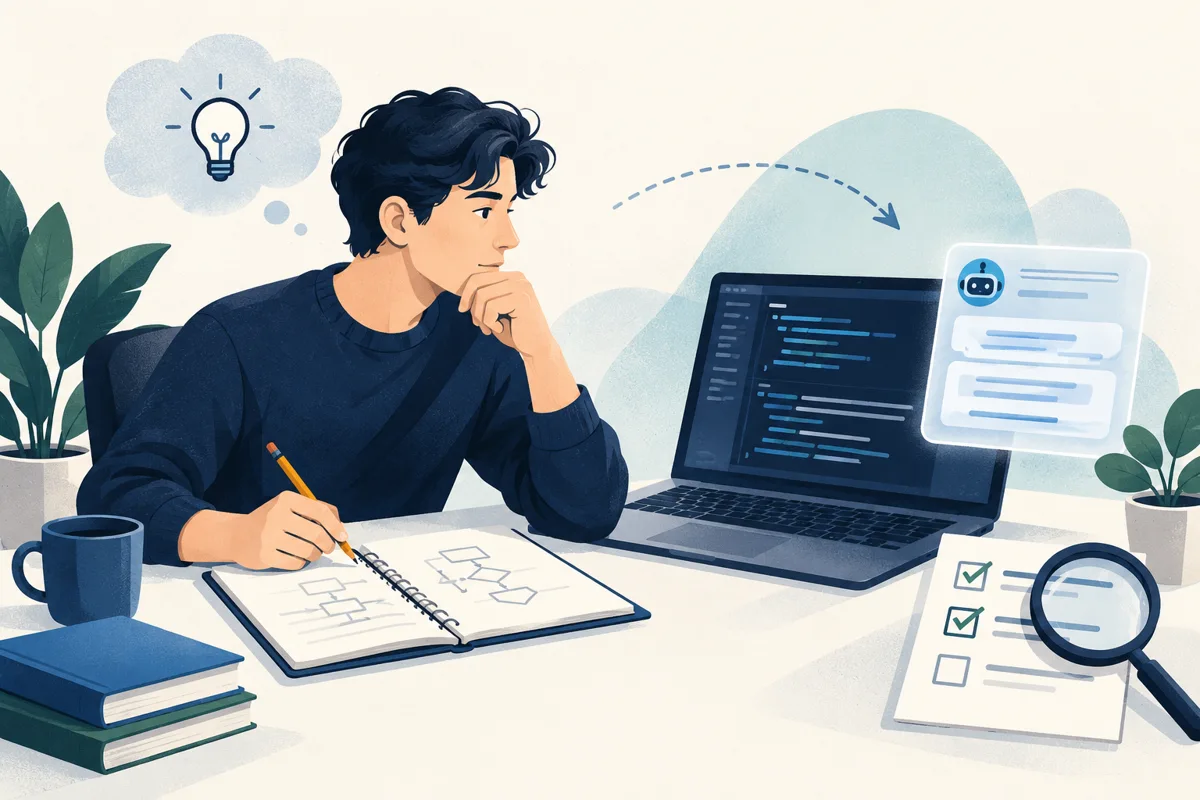
Use this 25-minute rehearsal with the code drill below:
- Analyze alone (5 min): state the contract and trace one input. Write down a suspected failure before opening AI.
- Ask narrowly (5 min): “Review this function for boundary errors. Give a counterexample; do not rewrite it.” Save the response.
- Check the output (10 min): run your own tests, reject unsupported claims, and make the smallest justified fix.
- Explain aloud (5 min): describe what AI missed, your evidence, complexity, and remaining assumptions.
What changes with AI
These are practice priorities, not claims about Google’s scoring criteria.
| Skill | Keep practicing | Add when AI is allowed |
|---|---|---|
| Problem solving | Algorithms, data structures, complexity | Bounded prompts and independent baselines |
| Code review | Tracing, debugging, edge cases | Counterexamples to plausible suggestions |
| Communication | Requirements and tradeoffs | Evidence for accepting or rejecting output |
Code review drill
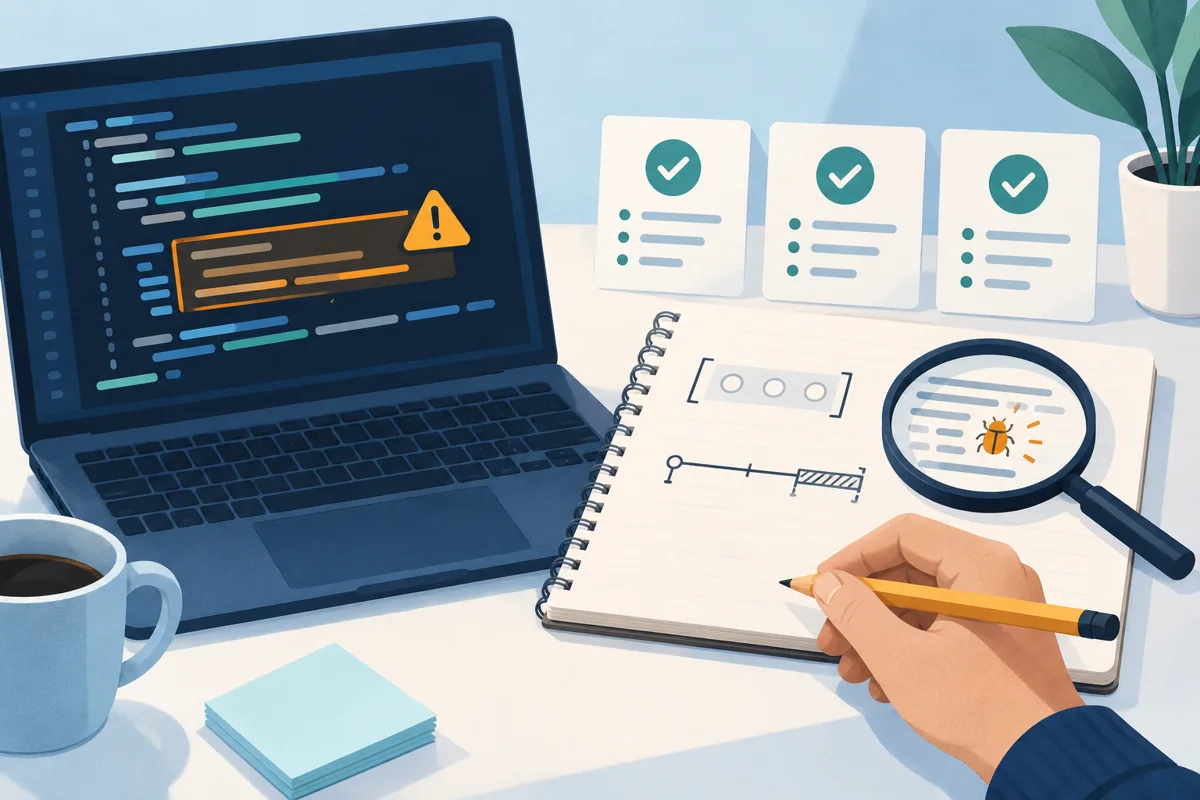
Contract: return the first index whose value is at least target in a sorted list, or len(nums) if none exists. Inspect this flawed Python implementation:
def lower_bound(nums, target):
    lo, hi = 0, len(nums) - 1
    while lo < hi:
        mid = (lo + hi) // 2
        if nums[mid] < target:
            lo = mid + 1
        else:
            hi = mid
    return lo
Simulated AI response: “The empty list returns zero, and duplicates converge to the first match, so it looks correct.” This deliberately incomplete review is a rehearsal fixture, not a recorded model response.
Find the omission: [1, 3], target=4 returns 1; the contract requires 2. The closed upper bound cannot reach the insertion position after the last element. Change only hi = len(nums) to search a half-open interval.
Validate the fix: run ([], 4) → 0, ([1, 3], 4) → 2, ([2, 2, 4], 2) → 0, and ([1, 3], 0) → 0. Explain why mid < len(nums) whenever the loop reads an element; time remains O(log n), space O(1).
Score your practice
Score each item 0 (missing), 1 (partial), or 2 (demonstrated): independent diagnosis, focused prompt, counterexample, regression tests, and spoken explanation. Aim for 8/10 with no zero for verification. This is a self-assessment rubric, not Google’s hiring bar.
A one-week plan
- Days 1–2: one code-reading drill daily. Save a diagnosis, rejected suggestion, and passing tests; pass when you expose the omission unaided.
- Days 3–4: solve one classic coding problem daily, then allow one AI check. Submit code and a complexity explanation; pass when both withstand a counterexample.
- Day 5: rehearse system design. Produce an assumption log; justify one rejected AI suggestion.
- Day 6: record a debugging story. Include your action, evidence, and outcome; remove unsupported claims.
- Day 7: complete a timed mixed mock. Keep a decision log and score it using the rubric above.
Software engineer interview prep for Google AI-assisted interviews should leave you able to defend every decision, with or without assistance.