
Disney layoffs November 2026 reports have raised a question that reaches beyond one company: what do repeated cost reductions mean for people building careers in entertainment? Reuters reported on November 2 that Bloomberg, citing people familiar with the matter, said Disney was considering thousands of job cuts and asking some managers to target 20% in annual cost savings. The updated Reuters report said Disney had not immediately responded to a request for comment. Reuters, November 2
The distinction matters. A savings target does not establish a workforce reduction of the same percentage, and the report does not confirm which technical teams would be affected. The wider context is nevertheless relevant: Disney has already reduced staffing this year, other entertainment companies are reorganizing, and US production employment was substantially below its 2022 peak well before this latest report.
Information checked November 4, 2026. The November plan remains media reporting: Deadline reported that Disney declined to comment, and the reports reviewed do not establish a final headcount or schedule.
Reported Layoff Plans
The November report describes potential Disney job cuts in 2026, not a completed layoff announcement. Three distinctions matter:
- Scope remains unconfirmed. Reuters did not establish a final headcount, affected departments, timing or severance terms. Reuters, November 2
- Savings are not headcount. The reported 20% annual savings target cannot be translated into a 20% workforce reduction.
- Check the specific role. Ask recruiters about budget approval, hiring timelines and team priorities; an active job advertisement alone does not confirm these. Employees should rely on direct company communications about their roles.
Entertainment Job Trends
Disney’s Earlier Cuts
Disney had already reduced staffing before November. Variety reported on September 30 that a few hundred employees were being laid off, mainly in HR and IT, following rounds in April and July. It also cited management’s August discussion of reducing labor and administrative costs to fund growth. Variety, September 30
- Cost control and investment can coexist. Candidates should assess the purpose and funding of a specific role, alongside the company’s brand.
- Keep each round separate. Earlier IT cuts do not establish November’s scope, and adding them to an unconfirmed estimate would create a misleading total.
Industry Consolidation
Paramount and Warner Bros. Discovery offer a related example. Variety’s October 7 coverage cited a leadership memo acknowledging difficult workforce decisions during integration and a goal of more than $6 billion in annualized savings over three years. The extent of cuts was undisclosed. Variety, October 7
- Different triggers, related pressures. Integration raises questions about duplicated functions, shared infrastructure and operating priorities; Disney’s reported savings exercise has a different immediate trigger.
- Risk models are not confirmed losses. Los Angeles County’s August assessment identified exposure from production consolidation, location choices and overlapping operations. Its scenarios explain potential mechanisms, not announced cuts or a forecast for Disney. LA County assessment, August 19
Production Employment
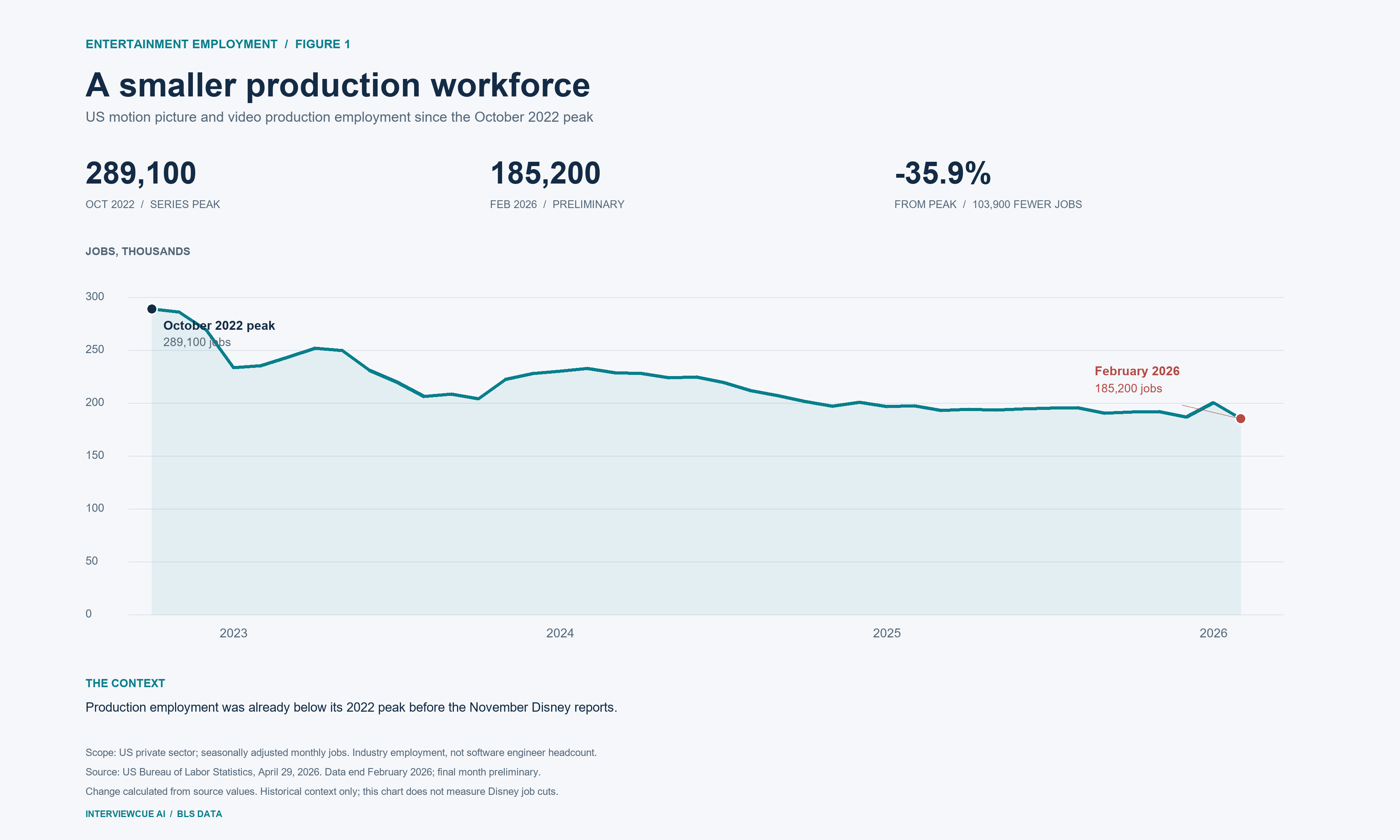
The broader labor data adds perspective. A BLS analysis published April 29, 2026, shows seasonally adjusted US motion picture and video production employment falling from 289,100 in October 2022 to 185,200 in February 2026. That is a decrease of 103,900 jobs, or approximately 35.9%, calculated from the published values. February was preliminary in that release. BLS, April 29
 Open the full-resolution employment chart in a new tab
Figure 1. US motion picture and video production employment, October 2022 to February 2026. Source: BLS.
View full-resolution chart (new tab).This is a historical comparison, not a November employment reading. It covers an industry across the United States, not Disney alone, and does not identify software engineering occupations. It also should not be relabeled as the entire entertainment workforce: theaters, broadcasting and other activities have different boundaries.
BLS describes a recovery after the pandemic followed by a decline that persisted into early 2026, with the strikes beginning in 2023 contributing to that trajectory. A chart alone cannot assign the decline to one cause. Company restructuring, project decisions and shifts in production locations need their own evidence. BLS, April 29
For readers, the useful point is timing. The employment contraction predates the latest Disney coverage. Treating this news as a single isolated shock would miss that background, while treating it as proof that every entertainment role faces the same outlook would overstate what the data shows.
Questions for Candidates
Our reading is that technical candidates should assess how a role connects to the business supporting it. The questions to ask at the end of an interview guide can help you raise role-specific points. Ask:
- Is this a new position or a replacement?
- What is the team expected to deliver?
- Are responsibilities changing during restructuring?
When applying elsewhere, translate entertainment experience into relevant capabilities, such as service reliability, payments, data pipelines or infrastructure tradeoffs. Use your resume experience to build clear interview answers, supporting each claim with your actual contribution; sector conditions alone do not define a role’s risk.
Prepare Your Next Move
Start with one real target job description. Identify the relevant responsibilities, then choose a project that demonstrates them. Record the problem, your contribution, the decisions you made and the result you can substantiate. Keep confidential details out of application materials, and do not add impressive numbers that you cannot verify.
For example, a hypothetical streaming backend engineer could replace the vague phrase “worked on video services” with a precise account of owning retry logic, investigating incidents and coordinating a service change. The value comes from a truthful explanation of responsibility, rather than from the entertainment brand attached to the work.
InterviewCue AI’s resume optimization workflow can help organize relevant experience against the target role. Review the suggested wording yourself so that ownership, skills and outcomes remain accurate. The guide on tailoring a resume to a job description provides a starting point.
Then carry that same project into a role-specific mock interview. Practice explaining why you chose an approach, what failed, and how you would change the design under different constraints. InterviewCue AI’s mock interviews offer a way to rehearse those answers and identify explanations that need more work.
Prepare your career-move explanation with the same care. If you have not received a layoff notice, do not describe yourself as laid off. Explain what you want to contribute next and the responsibilities you are looking for. The goal is a consistent account across the resume, project discussion and motivation for moving.
The Disney layoffs November 2026 reports still require clearer scope. Candidates can prepare meanwhile by checking a target role, documenting one relevant project and practicing how to explain it. Start with InterviewCue AI’s resume optimizer or AI mock interview to turn that preparation into a concrete next step.