

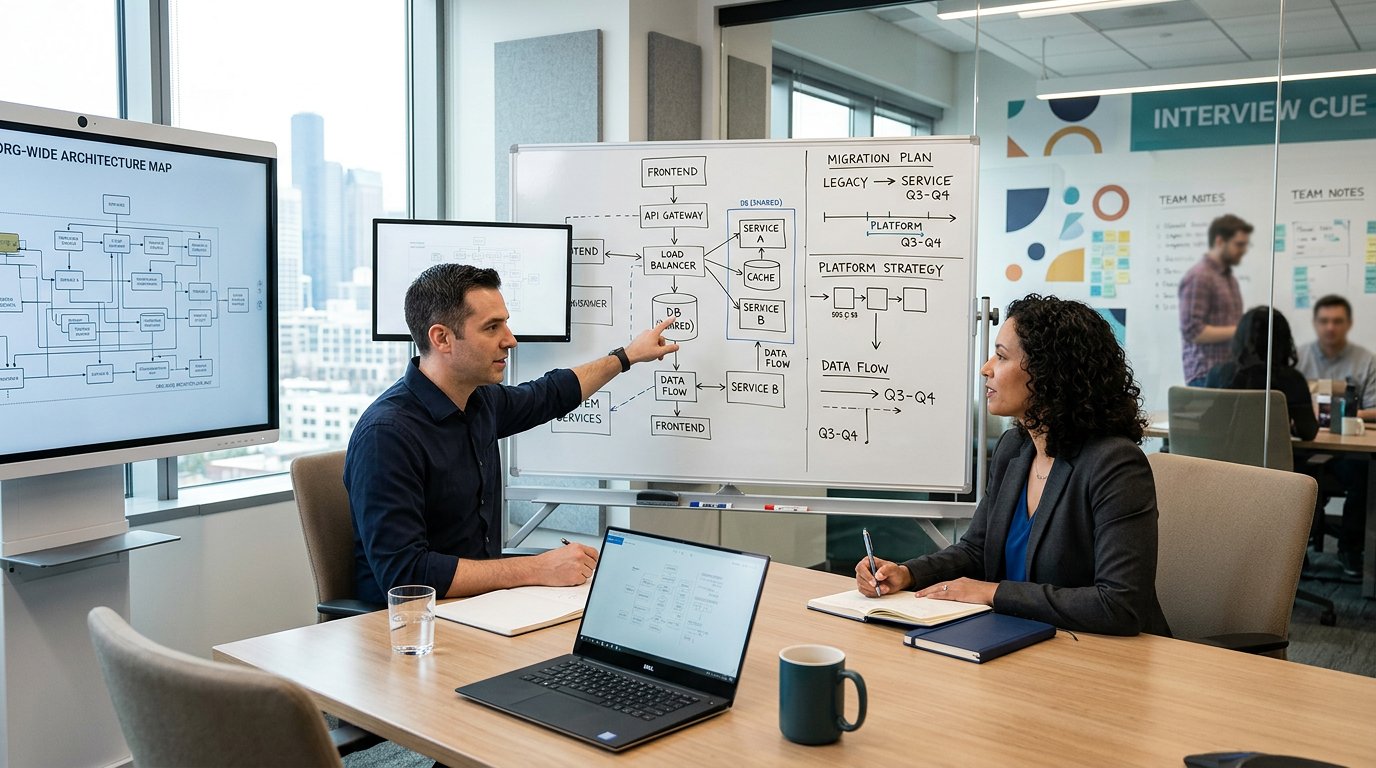
Principal engineer system design interview prep with AI should train you to speak at company scale. Principal-level interviews still build on the broader system design interview fundamentals, but they are rarely about whether you know common architecture patterns. They are about whether you can set technical direction across teams, reduce strategic risk, and keep a large engineering organization aligned while the system evolves.
InterviewCue helps when you want repeated rehearsal on those larger transitions. A principal candidate often knows the technical material already, but the interview bar depends on whether their answer sounds like a reusable strategy instead of a detailed implementation walkthrough. Strong practice should force you to connect architecture, adoption, governance, and execution in the same response.
What principal engineer system design interviews actually test
Principal system design rounds usually look for evidence that you can:
- Set direction across multiple teams and systems.
- Simplify complexity instead of expanding it.
- Balance platform investment against delivery pressure.
- Anticipate migration, compliance, and reliability risks, including the trust-boundary decisions covered in security system design interview practice.
- Influence without owning every line of implementation.
That is why the overlap between technical leadership interview AI coach work, staff engineer system design preparation, and software architecture interview practice matters so much. The design answer has to show both technical depth and leadership leverage.
How to prepare for principal engineer system design interviews with AI
How to prepare for principal engineer system design interviews with AI starts with choosing prompts at the right scope.
Instead of only practicing feature-sized systems, rehearse topics such as:
- Standardizing event architecture across product lines.
- Re-platforming identity or permissions across acquired products.
- Defining data boundaries for a multi-tenant platform.
- Designing an adoption path for a shared reliability layer.
Use the same structure in every answer:
- Define the business and organization problem.
- Describe the minimum architecture needed to solve it.
- Identify the biggest coordination or migration risk.
- Explain governance, ownership, and rollout sequencing.
- Close with metrics, checkpoints, and what you would defer.
This is where a live interview assistant is useful during rehearsal. InterviewCue can push on the exact follow-ups that distinguish principal from staff: which standards are mandatory, which teams need exceptions, what kills adoption, when the shared platform becomes too expensive, and how you would reverse a strategic mistake.
Principal engineer prep vs. staff engineer prep
Principal engineer system design interview prep with AI vs staff engineer prep is mainly about organizational surface area.
Staff interviews usually center on cross-team architecture, migrations, and delivery leverage inside a major area. Principal interviews often widen that frame to org-level consistency, platform standards, technical governance, and the tradeoff between local flexibility and company-wide simplicity.
A staff candidate may explain how to migrate one domain safely. A principal candidate may need to explain how several domains can adopt a shared model without stalling roadmaps or creating permanent exceptions. That difference is subtle, but it changes the quality bar for the whole answer.
Practice for org-wide architecture loops
Principal engineer system design interview prep with AI for org-wide architecture loops should focus on the questions interviewers use to expose weak strategic thinking.
Expect follow-ups such as:
- Which architecture choice becomes policy and which stays a recommendation?
- What would cause teams to resist adoption?
- Where would you allow duplication on purpose?
- How do you measure whether the platform is reducing total complexity?
- What decision would you postpone until you have more operational data?
Those questions are why behavioral interview for engineers habits still matter at principal level. A principal answer is not just a design. It is a decision-making model the rest of the organization can follow. Candidates whose target role owns staffing and delivery as well as architecture should compare this IC emphasis with engineering manager system design interviews.
That is also where InterviewCue can act like a role-aware live interview assistant. It helps candidates keep a long answer coherent while jumping between architecture, incentives, rollout risk, and executive communication.
How to evaluate coaching quality
The best principal engineer system design interview prep with AI should make strategic judgment easy to evaluate.
Look for practice that tests whether you can:
- State a strong default without pretending it fits every team.
- Define adoption boundaries and exception paths.
- Explain why complexity should move from one layer to another.
- Show how the architecture improves engineering throughput over time.
InterviewCue is strongest when it reveals whether you sound like a very strong implementer or like someone already operating at principal scope. That distinction is what most principal interview loops are actually measuring.
Principal engineer system design practice plan
Use this short principal engineer system design interview prep with AI guide before a leadership-heavy loop:
- Practice two prompts that affect several teams, not one service.
- Add follow-ups about governance, adoption, and metrics.
- Rehearse one answer for architecture depth and one for rollout strategy.
- Review whether the answer showed simplification, not just sophistication.
- End with the risk you would monitor most closely after launch.
The best principal engineer system design interview prep with AI makes your strategic technical judgment visible in a limited amount of time. InterviewCue is built for that kind of rehearsal, which is why principal engineer system design interview prep with AI can help candidates sound clearly principal-ready instead of only senior and articulate.