

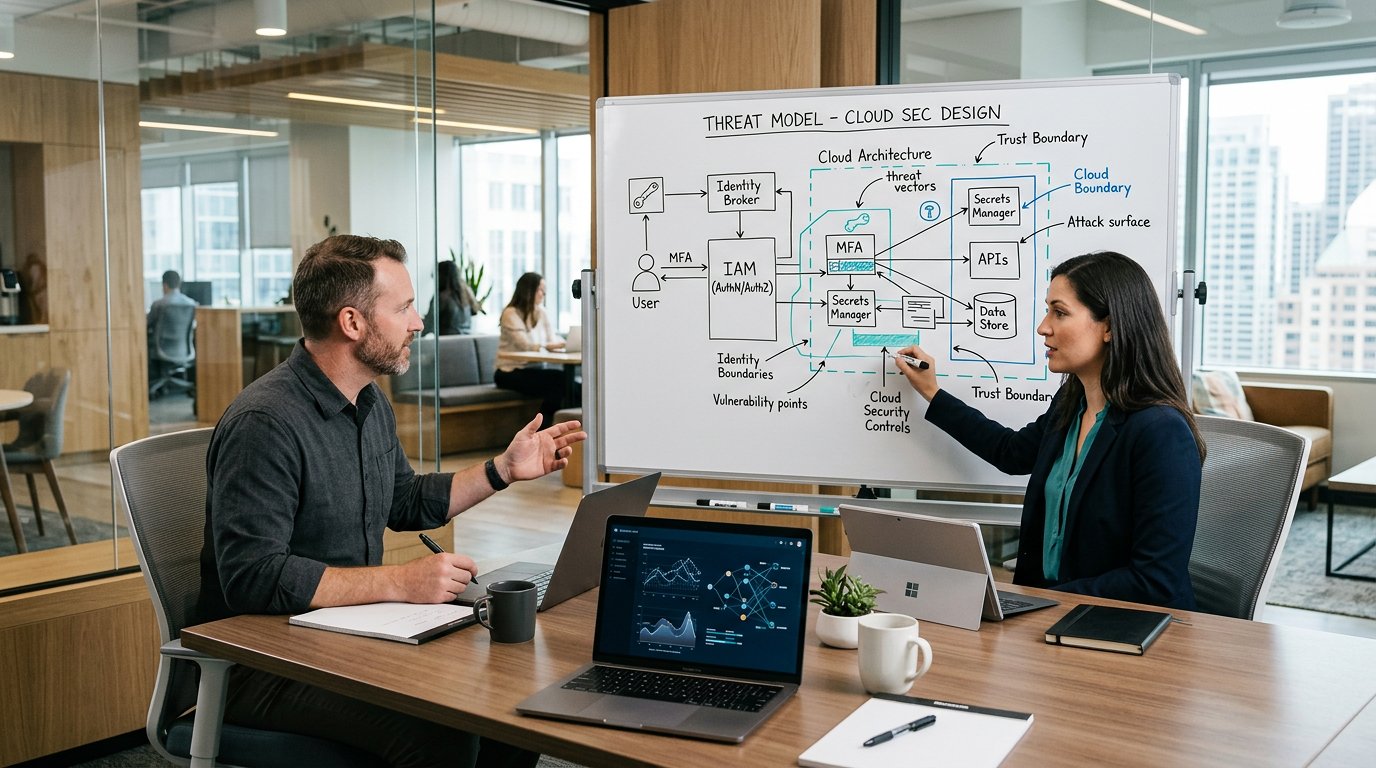
Security system design interview prep with AI should make your security judgment visible under pressure, not just help you recite controls. In a good security architecture round, the interviewer is listening for how you frame trust boundaries, prioritize abuse cases, and choose mitigations that a product team could actually ship. That is why the best prep sits between security engineer interview prep, a system design interview practice framework, and repeated practice on explaining tradeoffs clearly.
InterviewCue is useful when you want to rehearse that full answer shape. A candidate may know encryption, authentication, and logging patterns already, but still miss the security reasoning that makes the design convincing. Strong practice should force you to state the asset, the attacker, the exposure path, the mitigation, and the residual risk in a tight order.
What security system design interviews actually test
Security system design rounds usually test whether you can do four things at once:
- Understand the product workflow and likely failure points.
- Define trust boundaries and abuse paths clearly.
- Choose practical controls instead of maximal controls.
- Communicate security tradeoffs in language other engineers can use.
That combination is why software architecture interview habits matter for security roles. You are still designing systems, but you also need to explain why one identity model is safer, why one data flow creates unnecessary blast radius, or why one rollout plan reduces operational risk. Generic technical interview practice is rarely enough on its own.
How to prepare for security system design interviews with AI
How to prepare for security system design interviews with AI starts with realistic prompts rather than abstract security trivia.
Practice scenarios such as:
- Designing authentication for an internal admin surface.
- Securing a document-sharing workflow with role-based access.
- Reviewing a public API that handles sensitive user data.
- De-risking a service-to-service architecture across multiple teams.
For each scenario, answer in the same order:
- Clarify the system goal and assets at risk.
- Define the most important actors and trust boundaries.
- Identify the highest-likelihood abuse cases.
- Choose controls that match the product constraints.
- End with logging, detection, and residual risk.
This is where an AI interview coach becomes helpful. InterviewCue can challenge a weak answer with follow-ups like: what happens if tokens leak, where is least privilege actually enforced, how would you contain tenant crossover, or what signal would tell you the control is failing in production. That kind of repeated rehearsal is more useful than memorizing a checklist.
Security system design prep vs. generic system design
Security system design interview prep with AI vs generic system design prep is mostly a difference in risk framing.
Generic system design answers often optimize for scale, latency, and maintainability first. Security design answers still care about those constraints, but they also need to explain what can go wrong when a boundary fails or when an attacker behaves differently from a normal user. The generative AI system design interview applies the same reasoning to prompt injection, data exposure, unsafe output handling, and excessive agency. A candidate might design a strong file-sharing system and still sound weak if they never mention signed URLs, permission inheritance, auditability, or revocation latency.
That is why security candidates should practice with both a technical interview framework and a security lens. You need to sound like someone who can collaborate with backend, product, and platform teams instead of dropping security jargon on top of a normal architecture answer.
Practice for AppSec and cloud security roles
Security system design interview prep with AI for AppSec and cloud security roles should reflect the differences between those paths.
For AppSec, expect more discussion about secure defaults, code-level attack surfaces, secrets handling, SSRF or injection paths, and how to influence development teams before launch. For cloud security, expect more emphasis on IAM boundaries, network segmentation, account structure, telemetry, and reducing blast radius across shared infrastructure.
In both cases, a good system design mock interview AI coach should ask operational questions too:
- How would you roll this out safely?
- What would you log first?
- Which misconfiguration is most likely?
- Where is the single point of excessive privilege?
- How would you prove the control still works six months later?
That overlap is why security engineer interview prep and technical leadership interview AI coach work can reinforce each other. Senior security interviews are rarely only about finding issues. They are also about steering design decisions before those issues become incidents, which overlaps with the governance and influence expected in principal engineer system design preparation.
How to evaluate coaching quality
The best security system design interview prep with AI should expose weak assumptions quickly.
Look for practice that forces you to:
- Name the threat model before naming the tooling.
- Compare control options instead of assuming one right answer.
- Discuss user friction and delivery constraints honestly.
- Show how the team would detect failure after launch.
InterviewCue is strongest when it keeps your answer grounded in real engineering constraints. That matters because interviewers want a candidate who can improve a design in production, not just pass a whiteboard puzzle.
Security system design practice plan
Use this short security system design interview prep with AI guide for a focused prep week:
- Rehearse one authentication design, one data-protection design, and one incident-informed redesign.
- Add attacker-style follow-ups after every first answer.
- Practice explaining the same design to both a security peer and a product engineer.
- Review whether your answer made the trust boundary explicit.
- End with one sentence on residual risk and next hardening step.
The best security system design interview prep with AI helps you sound like a partner who can make systems safer without losing delivery reality. InterviewCue is built for that kind of rehearsal, which is why security system design interview prep with AI can make strong security judgment easier for hiring panels to trust.