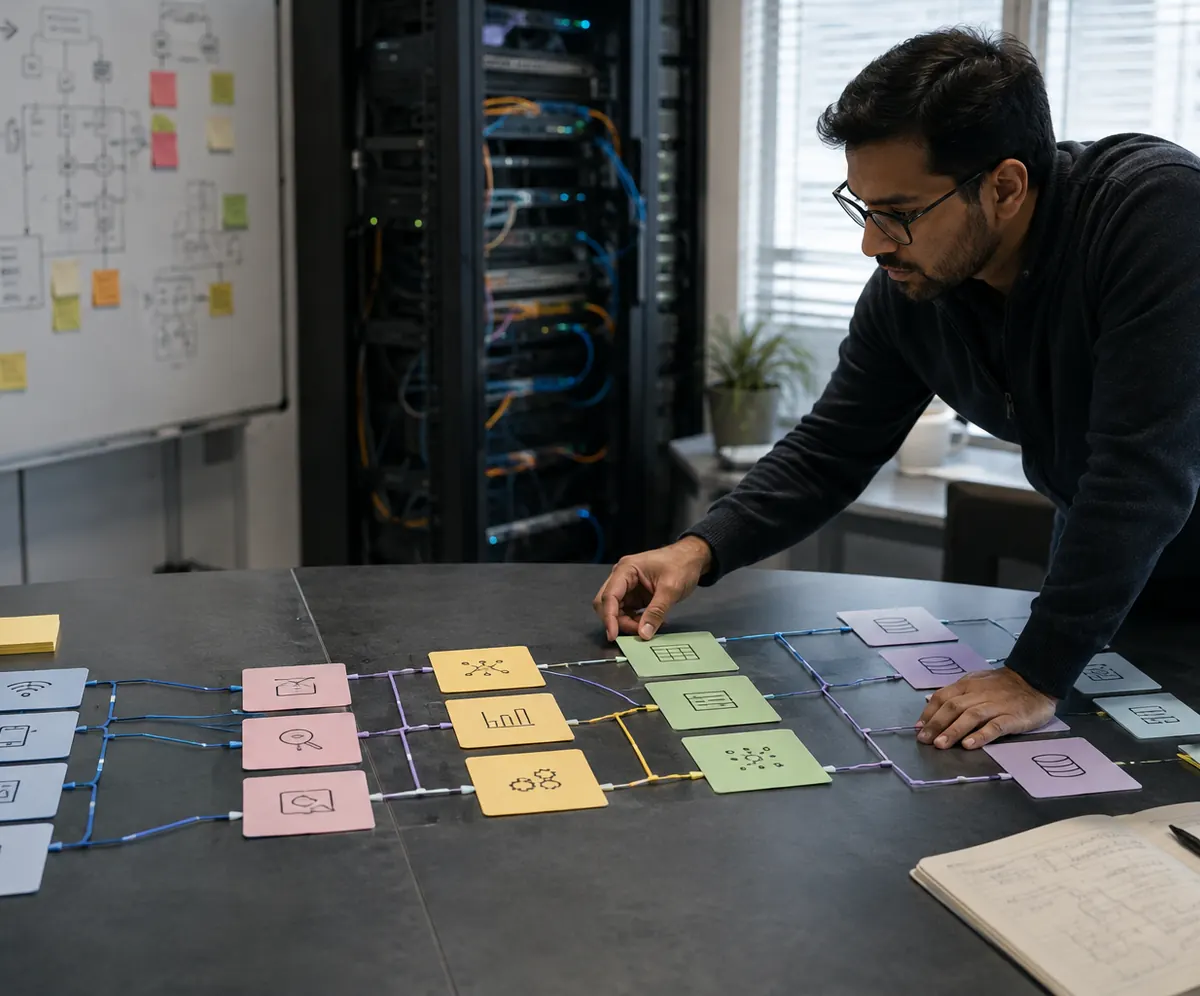
An end-to-end design conversation
A machine learning system design interview asks you to turn a broad product problem into a working ML system—from data collection through production monitoring.
About Cookies and Data Collection
Analytics and marketing are enabled by default on this website. Cookies and similar technologies help us understand website use, measure advertising and improve our services.
Choose Customize to turn either category off, or Accept to keep both enabled. Your saved choices apply on future visits. Closing this dialog keeps the current settings.
For more information, please read our Privacy Policy and Cookie Policy.
Cookie settings
Always activeFunction:
These cookies and similar technologies are used for activities that are strictly necessary to operate or deliver the service you requested from us.
Machine Learning System Design Interview
Prepare for ML system design interviews with a clear, production-minded framework—from product metrics and training data to online serving, monitoring, and feedback loops.
Define trustworthy events, labels, sampling rules, and quality checks before choosing a model.
ML system design interview explained
Machine learning system design turns a product goal into a production ML system that can learn from data, make reliable decisions, and improve over time. In an interview, you must connect the complete lifecycle while explaining the tradeoffs behind every major decision.
A machine learning system design interview asks you to turn a broad product problem into a working ML system—from data collection through production monitoring.
The round is a collaborative technical discussion. The interviewer changes constraints and probes your assumptions rather than waiting for one correct diagram.
Strong candidates connect model quality to product metrics, latency, cost, safety, reliability, data quality, and the simplest viable baseline.
General system design emphasizes APIs, storage, scale, and reliability. ML systems design also covers labels, training, evaluation, serving, drift, and feedback loops.
The offline learning system creates and validates model artifacts. The online decision system turns live inputs into reliable product outcomes.
Offline learning systemCreate and validate a reproducible model artifact
Online decision systemTurn live context into a reliable product decision
Strong answers explain the contract between both systems: shared feature definitions, model versions, feedback, and safe behavior when data or models fail.
Designing machine learning systems in an interview
Use this six-step framework to design a machine learning system in an interview. It helps you structure the conversation, design ML systems around production constraints, and explain the tradeoffs behind every major decision.
 Frame the problem
 1 / 6
Once the six-step structure is clear, use the ML system design interview practice guide to rehearse recommendation, ranking, serving, and monitoring tradeoffs under follow-up pressure. If the prompt centers on an LLM product, continue with the generative AI system design interview guide for retrieval, evaluation, safety, latency, and token cost.
Question examples and answer plans
These ML system design interview questions cover recommendation, search ranking, fraud detection, ads prediction, moderation, and forecasting. Open each one for a compact answer plan, then expand it with assumptions, estimates, alternatives, failure modes, and interviewer follow-ups.
Build candidate generation and ranking around user value, freshness, cold start, and measurable online impact.
Clarify the surface and objective first. Separate candidate generation from ranking, define user and item features, explain training examples and negative sampling, then cover online feature freshness, exploration, cold start, latency, and how an A/B test measures product impact.
Connect query understanding, retrieval, multi-stage ranking, relevance labels, and a strict serving budget.
Begin with query and document understanding, retrieval, and ranking stages. State relevance labels and offline metrics, then discuss index freshness, feature computation, multi-stage ranking, caching, tail latency, online evaluation, and graceful fallback when a model is unavailable.
Balance false positives and false negatives while handling label delay, adversarial drift, and review queues.
Define the cost of false positives and false negatives, label delay, and decision latency. Combine rules with a model, explain class imbalance and threshold selection, and include a review queue, adversarial drift monitoring, auditability, and safe rollout controls.
Predict at auction speed while accounting for delayed feedback, position bias, calibration, and user guardrails.
Clarify the auction objective and serving budget. Cover impression and click logging, delayed labels, position bias, feature freshness, calibrated predictions, low-latency inference, experiment design, and guardrails that prevent short-term clicks from harming user value.
Combine policy-aware models, threshold tiers, human escalation, appeals, and continuous adversarial monitoring.
Define policy categories and severity, then design multimodal signals, threshold tiers, human escalation, appeals, and regional constraints. Discuss rare-event evaluation, reviewer agreement, adversarial behavior, latency, monitoring, and how policy changes propagate safely.
Translate forecast horizons and uncertainty into operational decisions across products, regions, and time scales.
Clarify forecast horizon, granularity, and the operational decision it supports. Explain historical features, seasonality, backtesting, uncertainty intervals, cold start, reconciliation across levels, drift, and fallback behavior when data is late or abnormal.
Take one of these prompts into the system design mock interview framework and repeat it with a changed latency, freshness, privacy, or scale constraint.
End-to-end worked example
This end-to-end case study applies the framework to a personalized content feed. The goal is not to memorize one architecture, but to show how requirements, data, models, serving constraints, evaluation, and feedback shape the design.
Recommend relevant content for millions of users without letting model complexity overwhelm the latency budget or the fallback path.
Trace the request first. Then close the learning loop.
Define where recommendations appear, which user action the product should improve, how frequently the feed changes, and what a poor recommendation costs.
Optimize for meaningful engagement and retention instead of clicks alone, which can reward repetitive or misleading content.
Log impressions, clicks, dwell time, hides, saves, and downstream conversions so the model can distinguish ignored content from content a user never saw.
Protect training data from leakage, position bias, popularity bias, and incomplete feedback before increasing model complexity.
Combine recent, popular, similar-item, user-history, and collaborative-filtering candidates before deduplication and ranking.
Add ranking stages only when the expected relevance gain justifies extra latency, infrastructure, and debugging cost.
Retrieve fresh user and item features, score a bounded candidate set, apply policy and diversity filters, and return results inside the request budget.
Share feature definitions between training and serving, and avoid caching final rankings long enough for recommendations to become stale.
Measure retrieval and ranking quality offline, then validate product impact through a controlled online experiment and gradual rollout.
Track product outcomes, model quality, feature freshness, latency, errors, coverage, and diversity as separate signals.
Use contextual or popularity-based recommendations for new users, reserve exploration traffic for new content, and plan for missing features or unavailable models.
Return a safe, useful feed when personalization fails instead of delaying or failing the entire request.
Close with the tradeoffs
A stronger ranker can improve relevance but add latency and cost. Fresher features improve personalization but demand more infrastructure; exploration improves learning signals but may reduce short-term engagement.
Repeat the recommendation prompt while changing latency, freshness, scale, or cold-start constraints.
Practice with an AI mock interviewMove from resume analysis to realistic ML system design practice and permitted live interview support with the same InterviewCue workflow.

Get real-time AI interview assistance with clear answer cues during live interviews.

Practice role-specific questions and get actionable feedback in a personalized AI mock interview.
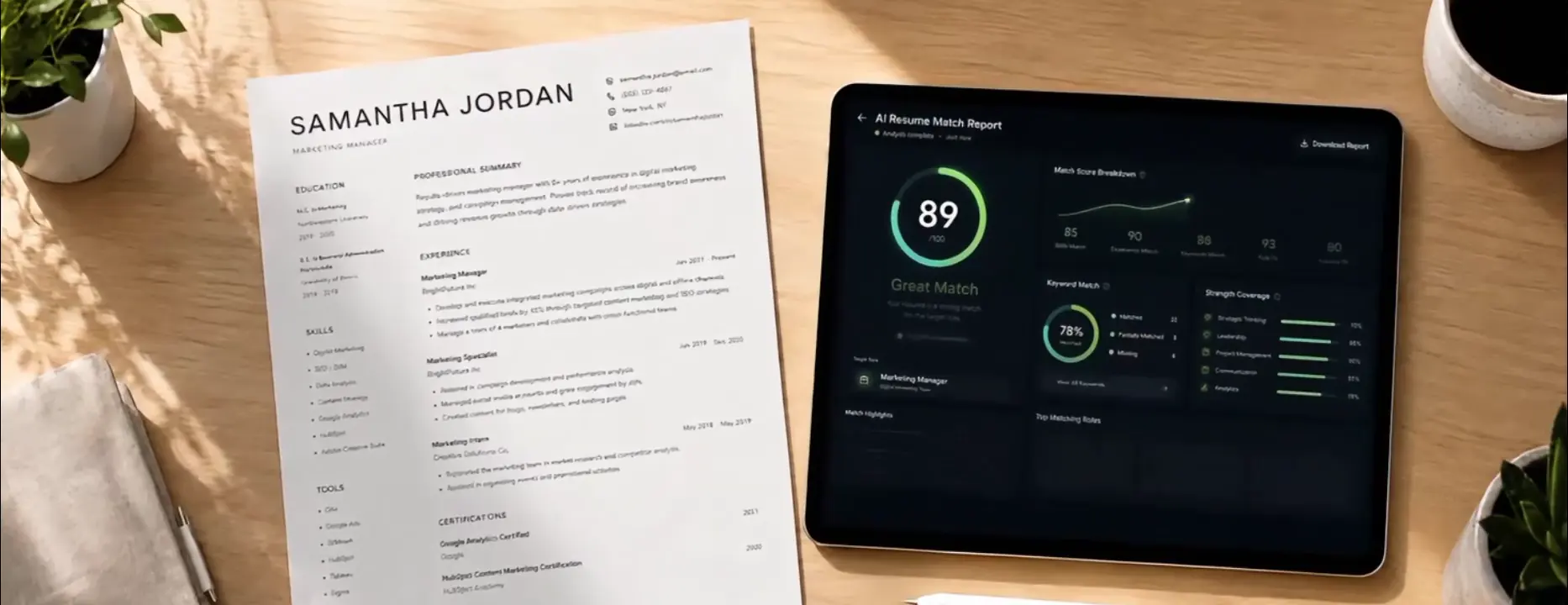
Check ATS alignment, role fit, and interview risks with an AI resume checker.
Question banks and interview tools
Explore question banks organized by company and role, free-to-try interview tools, and a broad library of practical articles and guides—all designed to support different stages of your interview preparation.
01 / 04
Frequently asked questions
Clear answers about the format, framework, questions, metrics, and preparation resources.
A machine learning system design interview is an open-ended technical discussion about designing an end-to-end production ML system. You are expected to connect a product goal to data, labels, features, training, evaluation, serving, monitoring, experimentation, and feedback loops while explaining tradeoffs.
General system design focuses mainly on software architecture, APIs, storage, scale, and reliability. An ML systems design interview includes those concerns but also probes label quality, feature freshness, training-serving consistency, offline and online evaluation, model drift, experimentation, and retraining.
Use a repeatable sequence: clarify the product goal and metrics, establish a baseline, design data and labels, choose features and a model, plan training and offline evaluation, design online serving, then cover experimentation, monitoring, fallbacks, and retraining.
Common prompts include recommendation, search ranking, fraud detection, ads prediction, content moderation, forecasting, spam detection, anomaly detection, and personalized feeds. The product changes, but the evaluation, serving, monitoring, and feedback-loop decisions are highly transferable.
Usually the main task is architecture and reasoning rather than implementation, although the exact format varies. You may be asked to sketch APIs, schemas, feature definitions, loss functions, evaluation logic, or pseudocode, so confirm the expected depth at the beginning.
Discuss business or product metrics, offline model metrics, and operational metrics separately. The right set depends on the prompt, but you should explain why each metric matters, how it is measured, and where metrics can be misleading.
Look for end-to-end production coverage, realistic case studies, exercises that force tradeoffs, and material on data quality, deployment, experimentation, monitoring, and failure recovery. A useful resource should help you explain decisions, not just memorize diagrams.
Practice one framework across several prompts, speak your reasoning aloud, draw the data and serving paths, and ask for changing constraints. Use InterviewCue for role-aware questions and follow-ups, then review whether your metrics, risks, fallbacks, and tradeoffs were explicit.
From components to a coherent answer
Practice the ML system decisions interviewers probe—from the first product question to the final monitoring and retraining tradeoff.